Footwear
What Rain Taught Me About Wearing Good Leather Shoes
A seasoned case for choosing, protecting, and rescuing fine footwear when the forecast turns hostile.
By Michael Mammela·
Search for style guides, grooming tips, and wardrobe advice.
Footwear
No single piece of footwear has demonstrated the same breadth of application across six decades of menswear. A defence of the most versatile boot ever made.
A pair of polished black Chelsea boots against clean white flooring
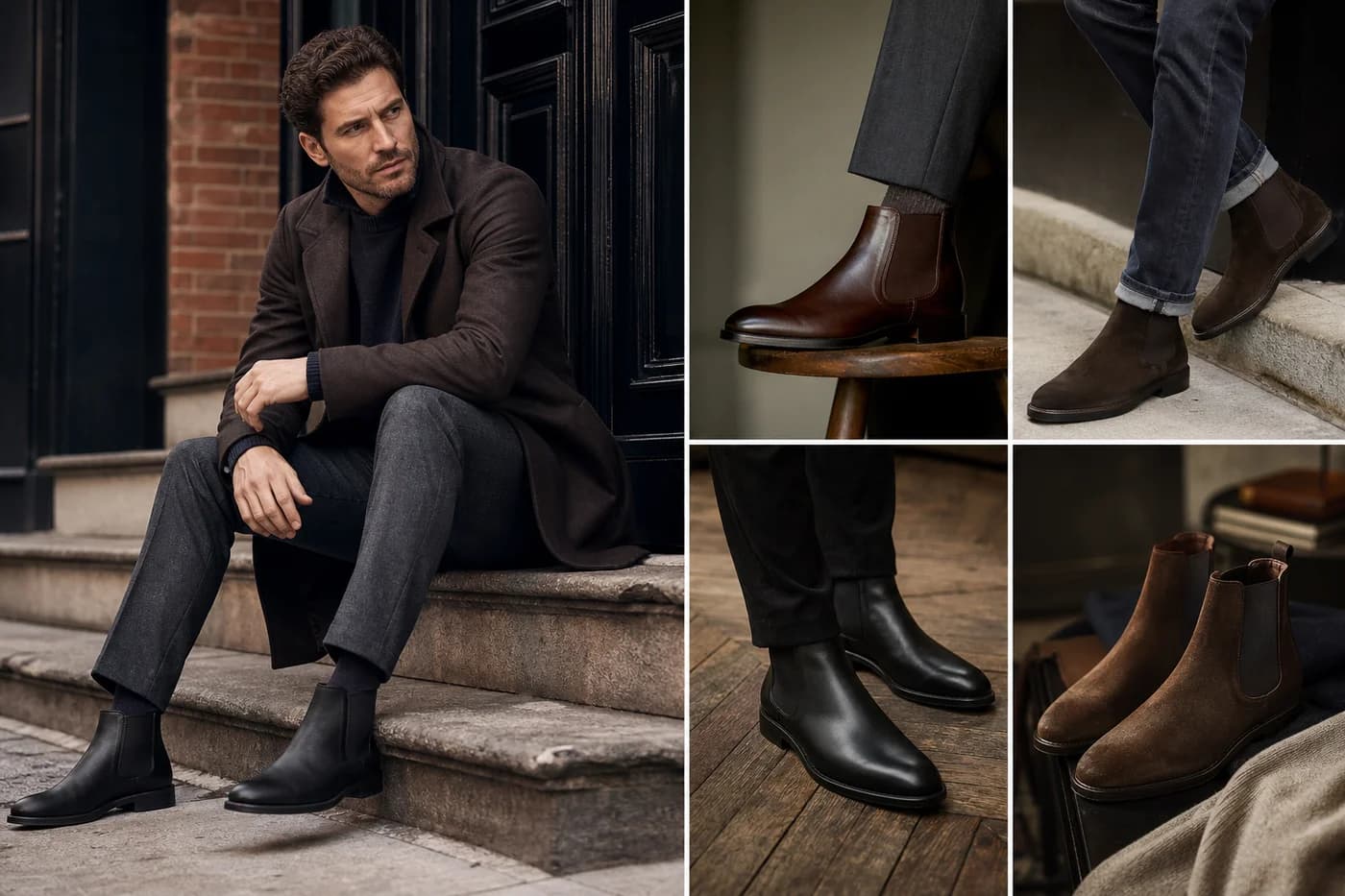
In a wardrobe with finite space and infinite demands, the Chelsea boot earns its place more comprehensively than almost any other shoe. It dresses up with a suit. It anchors a casual outfit with a clean, finished silhouette. It travels well. It has been worn by Mick Jagger and by every quietly dressed man who has ever understood that elegance is about reduction, not addition.
The Chelsea boot's origin is typically traced to the mid-nineteenth century, when J. Sparkes-Hall, boot maker to Queen Victoria, is credited with producing an ankle boot with an elastic side panel — a novelty made possible by Goodyear's 1844 vulcanised rubber patent.
The boot's cultural moment came a century later in Chelsea, London, in the late 1950s and early 1960s, when it became the footwear of the mod movement. Worn with drainpipe trousers and a sharp-cut jacket, it communicated youth, modernity, and a rejection of the heavy footwear of the previous generation. The Beatles wore them.
The Chelsea boot has lasted because its structure solves a genuine problem: how to create a boot that is as easy to slip on as a loafer, as clean in silhouette as a dress shoe, and as versatile as a trainer. The elastic gusset eliminates laces; the low heel and close-cut toe create a lean profile that reads as intentional from any angle.
"The man who owns one pair of excellent Chelsea boots owns a shoe that works in almost any context that does not require formal lace-ups or serious outdoor footwear. That is a remarkable return on a single purchase."
The variables that separate a Chelsea boot worth owning from one that will disappoint you within a year are relatively few but significant:
The case for the Chelsea boot rests not on fashion but on function. It is an elegant solution to the problem of footwear that must work across contexts without requiring a wardrobe of alternatives. Buy the best pair you can afford, have them resoled when necessary, and wear them for twenty years. This is, in miniature, the whole philosophy of Sartorial.
Topics
About the Author
Style Director
Michael is the co-founder of Sartorial and its Style Director. With over a decade spent studying classic menswear from the ateliers of London to the tailors of Naples, he writes about the enduring principles that underpin a truly refined wardrobe.
Continue Reading
Footwear
A seasoned case for choosing, protecting, and rescuing fine footwear when the forecast turns hostile.