Occasions
Dressing for the Modern Occasion
Dress codes are not dying — they are evolving. Understanding what each occasion truly demands is the foundation of every well-dressed man's decision-making.
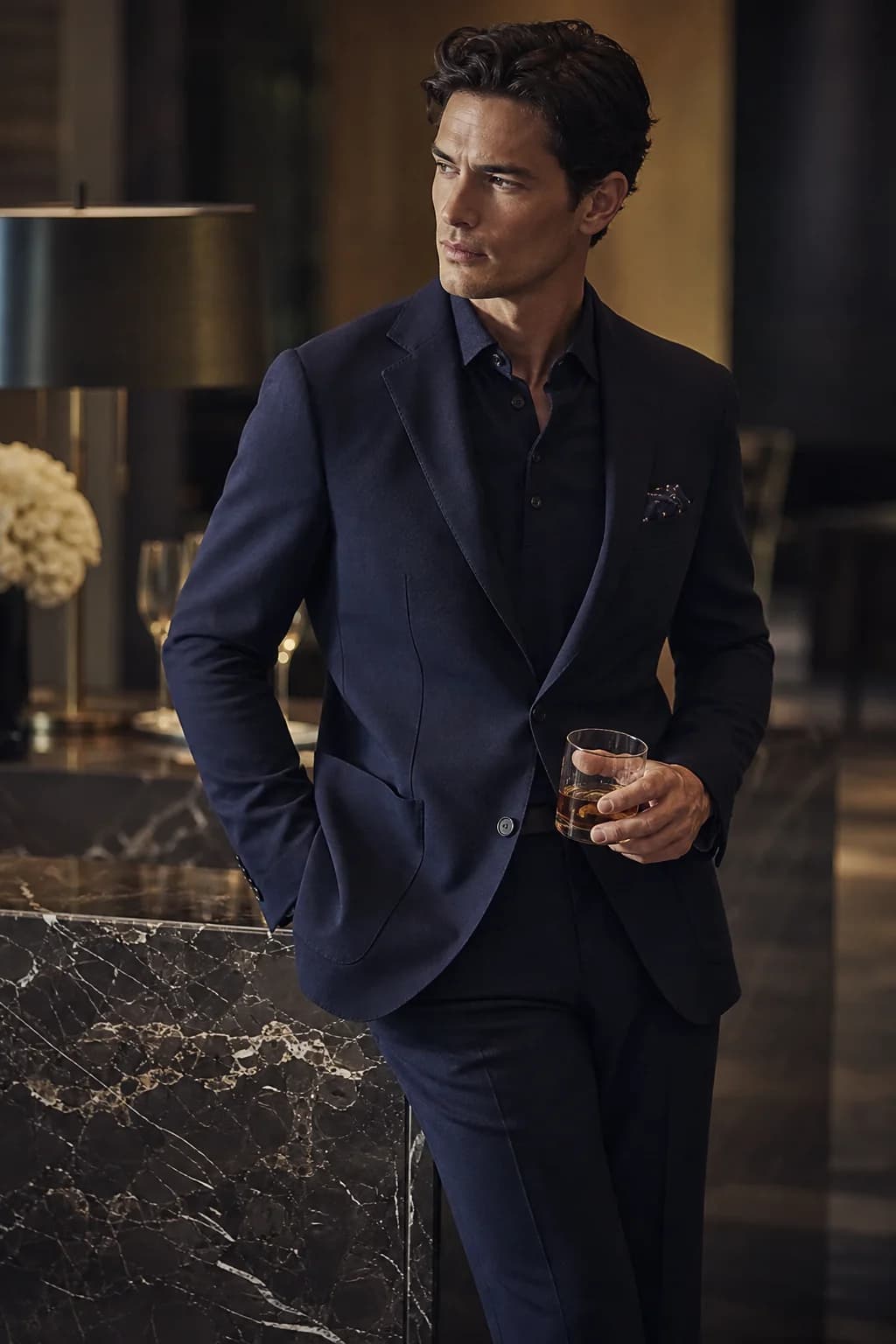
A man in a perfectly fitted black dinner jacket at a formal evening event
A dress code is not a constraint. It is a shared language — an agreement between host and guest about the register of the evening. Understanding that language, and speaking it fluently, is one of the most practical skills a well-dressed man can cultivate. And yet for most men, an invitation with a dress code attached produces more anxiety than any other social occasion.
The cause of that anxiety is usually one of two things: a wardrobe that has not been built deliberately, or a misunderstanding of what each dress code actually requires. Both are solvable.
Black Tie
Black tie is the most rigorously defined dress code in common use, and therefore the one that produces the most consistent errors. The fundamental rule is simple: black tie is a uniform, and deviations from it require confidence, context, and very good taste.
- The dinner jacket — Black barathea or midnight navy wool, single-breasted with a one-button fastening. Peaked or shawl lapel in silk or grosgrain. Midnight navy reads as black under most artificial lighting and is arguably more flattering on most skin tones.
- Trousers — Matching the jacket, with a single braid of silk down the outer seam. Never a belt; trouser braces are the correct and historically accurate fastening.
- Shirt — White, pleated-front or plain, with a stiff or semi-stiff collar. The collar must accept a bow tie — a four-in-hand knot at black tie communicates either ignorance or deliberate transgression. Both are noted.
- Bow tie — Black silk, self-tied. A pre-tied bow tie is visible for what it is, and what it is communicates that you could not be bothered to learn the knot.
- Shoes — Black patent leather Oxford or Derby. A well-polished black calf leather shoe is acceptable; brown shoes are not.
"Black tie worn correctly is not intimidating. It is equalising. Every man in the room is held to the same standard, and within that constraint, the quality of fit and fabric becomes the only remaining variable."
Business and Business Formal
Business attire exists on a spectrum, and understanding where your workplace sits on that spectrum is essential. In most contemporary office environments, the era of mandatory suit-and-tie has passed. What has replaced it is something harder to navigate: an unwritten code that varies by sector, seniority, and geography.
Reading the Room
- In financial services, law, and professional services: a suit remains the professional default. Navy or charcoal, with a white or pale blue shirt. The tie is increasingly optional at the associate level; it remains expected in client-facing situations.
- In technology and creative industries: the suit has been displaced by elevated casual — a well-fitted trouser, quality knitwear or an open-collar shirt, clean footwear. The measure here is not formality but quality of fit and fabric.
- In any environment, dressing one increment above the stated norm communicates that you take the situation seriously. It is never a social disadvantage to look more considered than the room.
Casual and Weekend
The weekend is where most men's wardrobes reveal their gaps. Having invested in a suit and a few formal shirts, many men find themselves at a loss when the setting is a friend's lunch, a gallery opening, or a relaxed dinner with no discernible dress code.
The principle that applies here is the same as it applies everywhere: intentionality. A casual outfit that has been considered — where the colours work together, where the proportions are correct, where the shoes are an active choice rather than an afterthought — communicates something very different from an outfit assembled at random.
- Proportion — When the top is fitted, the trouser can be relaxed. When the trouser is slim, the top can have some volume. Avoid fitted on fitted — it reads as sportswear — and avoid relaxed on relaxed — it reads as inattention.
- Fabric quality — At casual register, fabric is more visible, not less. A t-shirt in dense, high-quality jersey reads entirely differently from a thin, shapeless one in the same cut. The same is true of denim, knitwear, and casual trousers.
- Footwear — More than in any other context, footwear determines the register of a casual outfit. A clean, considered shoe or boot elevates the rest of the outfit. Worn-down, indistinct footwear reduces it.
Dressing well for any occasion is, in the final analysis, a form of consideration — for the host, for the other guests, and for yourself. The man who reads a dress code accurately and executes it with care communicates that he understands the world he moves through. That is not a small thing.
Topics
About the Author
Michael Mammela
Style Director
Michael is the co-founder of Sartorial and its Style Director. With over a decade spent studying classic menswear from the ateliers of London to the tailors of Naples, he writes about the enduring principles that underpin a truly refined wardrobe.